playing rules – interference & protection of the goaltender
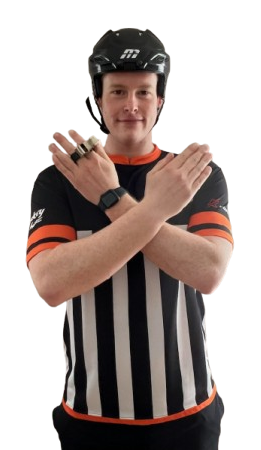
Rule 66. Interference/Protection of the Goaltender
(a) A Minor penalty for Interference or, at the discretion of the Referee, a Major penalty and a Game Misconduct penalty shall be assessed any player who:
(1) interferes with or impedes the progress of an opponent who is not in possession of the ball, or
(2) deliberately knocks a stick out of an opponent’s hand, or
(3) prevents an opponent who has lost or dropped their stick from regaining possession of it.
Note 1: The last player to touch the ball – other than the goaltender – shall be considered the player in possession.
Note 2: Often the action and movement of the attacking player causes the interference, since the defending players are entitled to “stand their ground” or “shadow” the attacking players. Players of the side in possession of the ball shall not be allowed to “run” deliberate interference for the ball carrier.
Note 3: Forcefully knocking the stick out of an opponent’s hand with the stick should be assessed as slashing rather than interference.
(b) A Minor penalty for Interference with the goaltender shall be imposed on a player who, by means of their stick or their body, interferes with or impedes the movements of the goaltender by actual physical contact. The penalty should be announced as “Interference with the Goaltender”.
Note: A goaltender is not “fair game” just because he is outside the goal crease. A penalty for Interference (Minor or, at the discretion of the Referee, a Major penalty and a Game Misconduct penalty) or Charging (Minor or, at the discretion of the Referee, Major penalty and a Game Misconduct penalty) shall be called where an opposing player makes unnecessary contact with the goaltender. Likewise, Referees should be alert to penalize goaltenders for Tripping, Slashing, or Spearing in the vicinity of the goal.
Unless the ball is in the goal crease area, a player of the attacking side may not stand in the goal crease. If an attacking player deliberately stands in the goal crease, without interfering with the goaltender, the Referees shall stop the play and the ensuing face-off shall take please at the nearest face-off stop in the neutral zone. If the ball should enter the net while such conditions prevail the goal shall not be allowed. If an attacking player has physically interfered with the goaltender, prior to or during the scoring of the goal, the goal will be disallowed and a penalty for “Interference with the Goaltender” will be assessed and announced.
The ensuing face-off shall be taken in the neutral zone, at the face-off spot nearest the attacking zone of the offending team.
If a player of the attacking team has been physically interfered with by the actions of any defending player so as to cause them to be in the goal crease and the ball should enter the net while the player so interfered with is still in the goal crease, the goal shall be allowed. A Minor penalty shall be assessed to an attacking player, who while their team has possession of the ball, is interfered with by a defending player, but fails to attempt to avoid making contact with the goaltender. In addition, if a goal is scored it shall be disallowed.
A Minor penalty shall be imposed on an attacking player, not in possession of the ball, who is tripped or caused to fall and fails to attempt to avoid contact with the goaltender whether he is in or out of their crease.
A Minor penalty shall be imposed on any attacking player, who makes deliberate contact with a goaltender whether in or out of the goal crease.
At the discretion of the Referee a Major penalty and a Game Misconduct penalty may be imposed under Rule 52 (b) – Charging or Rule 54 (c) – Cross-Checking. In the event that a goaltender has been pushed into the net together with the ball after making a stop, the goal will be disallowed. If applicable, the appropriate penalties will be assessed.
(c) Where a stick or any object is thrown on the floor from the players’ or penalty bench or where a player on the floor is interfered with by an opposing player or team official on the players’ or penalty bench, (whether or not play is in progress), a Bench Minor penalty shall be assessed to that team if the Referee is unable to identify the person responsible, except as covered in Rule 36 (a)(4) – Awarded Goals and Rule 85 (d) – Tripping. If a goal is scored, no Bench Minor penalty would be assessed.
(d) Where a stick or any object is thrown on the floor from the players’ or penalty bench or where a player on the floor is interfered with by an opposing player or team official on the players’ or penalty bench (whether or not play is in progress) and the Referee is able to identify the person responsible; that person shall be assessed a Bench Minor penalty and a Game Misconduct penalty. When Rule 36 (a)(4) – Awarded Goals or Rule 85 (d) – Tripping are applied, the Bench Minor penalty would not apply but the Game Misconduct penalty would.
(e) A Major penalty and a Game Misconduct penalty shall be assessed any player who injures an opponent by “interference”.
(f) A Minor penalty shall be assessed a goaltender who deliberately places obstacles at or near their net which, in the Referee’s opinion, would tend to prevent a goal from being scored.
A Penalty Shot shall be awarded to the non-offending team if, in the Referee’s opinion, such object or obstacle actually prevents a goal while the offending team’s goaltender is legally on the surface. If a Penalty Shot is awarded under this rule, the Minor Penalty shall not be assessed.
A goal shall be awarded if, in the opinion of the Referee, such object or obstacle actually prevents a goal after the offending goaltender has been legally substituted for by another player.
SITUATION 1
QUESTION: A player of the attacking team enters the opponent’s goal crease illegally with the ball in the attacking zone. The defending goaltender
slashes them. The Referee signals a delayed penalty on the goaltender and subsequently the attacking team scores a goal while the delayed penalty is still on, and the player is still in the crease. Is the goal allowed? Is the penalty to the goaltender assessed?
ANSWER: The goal is not allowed and a double minor penalty is assessed to the goaltender.
SITUATION 2
QUESTION: Team “A” shoots the ball from behind the centre red line so as to constitute a possible flooring call. A player of Team “A” who is onside and eligible to play the ball, attempts to do so in the opposing team’s end, before flooring occurs. The goaltender of Team “B” shoots a portion of a broken stick so as to interfere with the ball. What penalty is assessed?
ANSWER: Allow play to be completed. Assess the goaltender a Minor penalty for Interference.
SITUATION 3 Rule 66 (a)(1)
Where a player with a stick in their hands, shoots a broken stick or any other object on the floor at an opposing player and hits the opponent or interferes with their progress, whether or not they have the ball, assess a Minor penalty for interference. If the opposing player is injured by the broken stick, assess the guilty player a Major and Game Misconduct for Interference. A Match penalty may be assessed if, in the opinion of the Referee, there was either deliberate attempt to injure or deliberate injury.
SITUATION 3 Rule 66 (a)(1)
Where a player with a stick in their hands, shoots a broken stick or any other object on the floor at an opposing player and hits the opponent or interferes with their progress, whether or not they have the ball, assess a Minor penalty for interference. If the opposing player is injured by the broken stick, assess the guilty player a Major and Game Misconduct for Interference. A Match penalty may be assessed if, in the opinion of the Referee, there was either deliberate attempt to injure or deliberate injury.
SITUATION 4
Where a player is on a breakaway in the neutral or attacking zone, and a stick or other object on the floor is shot at them by an opposing player preventing them from getting a clear and unimpeded shot on the goal, then award a Penalty Shot under Rule 85 (d). Classify this as being fouled from behind and being prevented from having a clear shot on goal. If the player is able to get a clear shot on goal, only a Minor penalty for Interference would be assessed.
SITUATION 5 Rule 66 (d)
QUESTION: Would a penalty be assessed if a Team Doctor, who is identified as one of the five team officials occupying the players’ bench, throws an object on the floor?
ANSWER: Yes. A Bench Minor penalty plus a Game Misconduct would be assessed.
SITUATION 6 Rule 66 (b)
The key to understanding this rule is to realize that the onus is on the attacking player to avoid contact with the goaltender.
SITUATION 7 Rule 66 (f)
A team pulls its goaltender for an extra player. Before leaving their crease, the goaltender places their stick across the front of the goal, meanwhile their team scores a goal. The Referee, upon looking back to the other end of the rink, observes the stick across the front of the goal.
RULING: Wash out the goal and assess the goaltender a Minor penalty for Interference.
SITUATION 8 Rule 66 (f)
As the goaltender leaves the floor to be replaced by another player, they drop or place their stick in front of the net.
RULING: It is the responsibility of the goaltender to keep the area near their net free of any obstacles that may prevent a goal from being scored. For an infraction of this rule, whether or not the action is observed by the Referee, a Minor penalty shall be assessed. If when the goaltender has been removed, the ball is prevented from entering the goal due to the stick, the Referee shall award a goal.
Note 1: Use the goal crease as the guideline for this situation and any part of the stick in contact with any part of the goal crease would constitute an Interference infraction.
Note 2: If a player (as opposed to a goaltender) puts a stick in the crease with the goaltender off the floor, assess an Unsportsmanlike Conduct penalty under Rule 47 (a). If such action prevents the scoring of a goal, award a Goal under Rule 36 (b).
SITUATION 9 Rule 66 (f)
Where the goaltender, who is leaving the floor, drops or places their stick on the floor a considerable distance out from the goal crease, NO penalty may be assessed if the action was not observed by the Referee. If the action was observed by the Referee, then a Minor penalty for Interference shall be assessed. However, when the goaltender has been removed, if the ball is prevented from entering the goal because of the stick then the Referee shall award a Goal.
SITUATION 10 Rule 66 (f)
A goaltender in their crease places any object near the goal posts and goal line. The opposing team shoots the ball which in the opinion of the Referee is prevented from entering the goal by the objects. What is the correct ruling?
RULING: Assess the goaltender a Minor penalty for Interference. In this case a goal may not be awarded with the goaltender still on the floor



FOLLOW US!
LINKS
Events
Officials
News
CONTACT US
Send an Email
(647) 781-1818
Ontario Ball Hockey Federation © 2021