playing rules – fighting & roughing
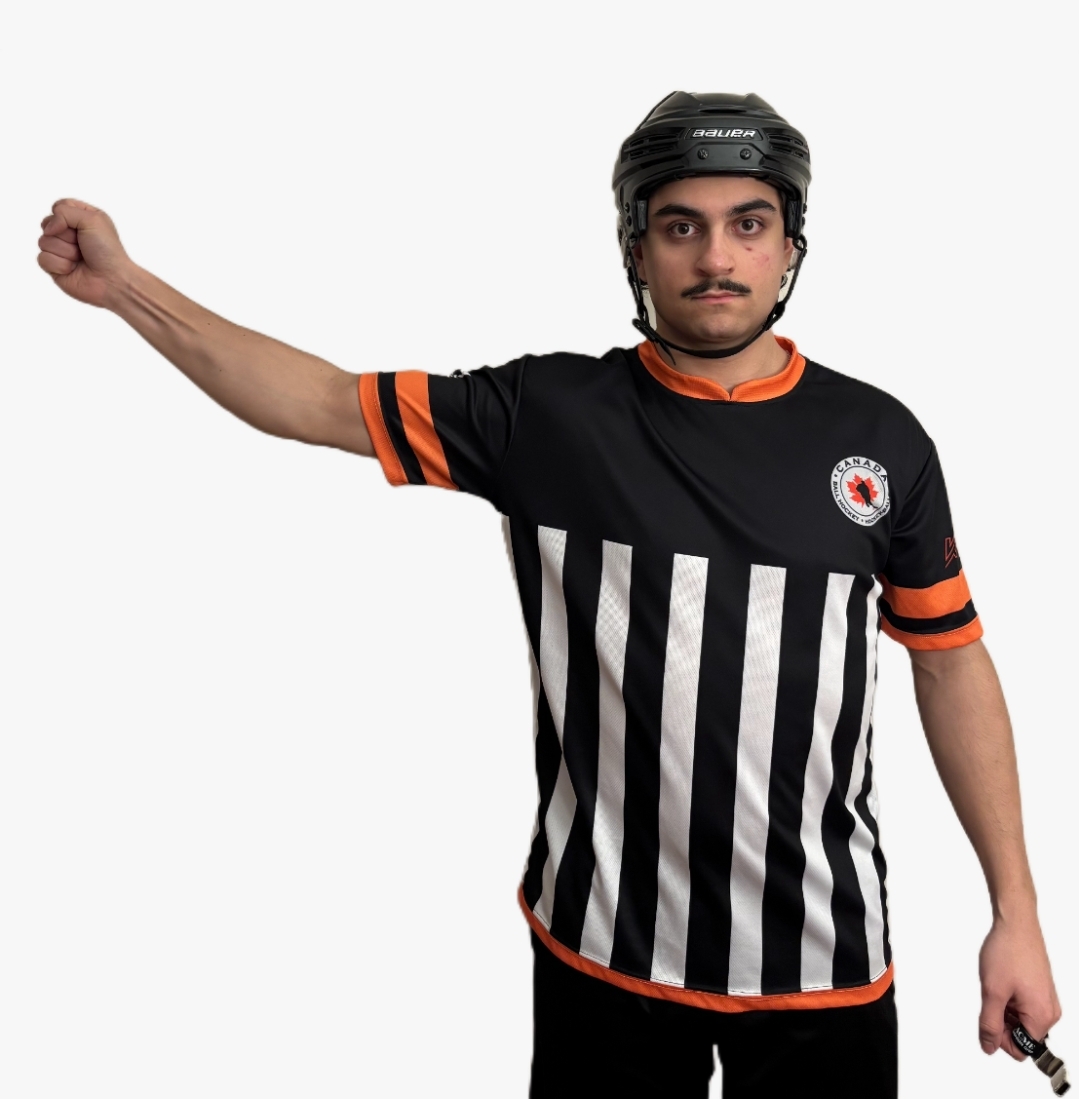
Rule 59. Fighting and Roughing
a) A Major penalty and a Game Misconduct penalty shall be assessed any player who fights with an opposing player.
(1) A player who is identified by the Referee as being the instigator, or the aggressor in a fight shall be assessed a Minor penalty, in addition to any other penalties they may incur.
(2) A Minor penalty shall be assessed any player who, having been struck, shall retaliate with a blow or attempted blow. Should such a player continue to retaliate, they shall be assessed a Major penalty and a Game Misconduct penalty.
(3) Any player who does not retaliate after being struck will not be assessed a penalty under this section, but may be assessed a penalty for a violation of other rules.
(4) Any player wearing a ring or rings, tape or any other material on their hands, who becomes involved in a fight and who uses such to gain an advantage or to inflict punishment and/or injury, shall be assessed a Match penalty in addition to any other penalties they may incur.
Note: The foregoing sections shall also apply to goaltenders.
(5) When a fight occurs, all other players except the goaltender shall immediately retire to the front of their respective benches or to a neutral zone (should the fight occur in front of a players’ bench) designated by the Referee and remain there until the Referee calls them back to resume play. The goaltenders must stay in their goal creases or proceed to a neutral zone designated by the Referee. Any player(s) refusing to do so after being instructed by the Referee shall be assessed a Misconduct penalty, plus any other penalty they may incur.
(b) A Major penalty and a Game Misconduct penalty shall be assessed any player who is involved in fighting with another player off the playing surface.
(c) Any player joining in a fight, acting as a peacemaker or taking part in another fight during the same stoppage of play, will be assessed a Game Misconduct penalty plus any other penalty the offender incurs under the rules.
(d) Any player or team official who becomes involved in a fight with a team official shall be assessed a Gross Misconduct penalty. This does not eliminate the possibility of further penalties being assessed for such an infraction.
(e) Branches are authorized, at the discretion of their members, to assess further penalties in the case of Rule 59 (a), for all players in all divisions of ball hockey.
(f) A Minor penalty or, at the discretion of the Referee, a Major penalty and a Game Misconduct penalty shall be assessed to any player who is guilty of unnecessary rough play.
Note 1: If the penalty assessed is for an infraction after the whistle, “Roughing after the Whistle” shall be recorded.
Note 2: The Major penalty for roughing is not to be confused with and utilized in lieu of the Major Penalty and a Game Misconduct Penalty for fighting.
(g) A Minor penalty or, at the discretion of the Referee, a Major and a Game Misconduct penalty shall be assessed any player who, in the Referee’s judgment, makes deliberate physical contact with an opponent after the whistle.
SITUATION 1 Rule 59 (g)
It is the opinion of the Canada Ball Hockey Association Board of Directors that too much contact is being made by players after the Referee has blown their whistle to stop play. The intent of this rule is to strictly penalize players who fail to obey the whistle. This unnecessary contact can be with the body or the stick. Officials are directed to strongly enforce this section with the appropriate penalty.
SITUATION 2
QUESTION: At a stoppage of play, a Team “A” player pushes a Team “B” player who then pushes back. What is the proper procedure for the Referee?
ANSWER: The Referee would assess the Team “A” player a Minor penalty for “Roughing after the Whistle”. Where the retaliation is too severe to be ignored and that player is penalized, then the Referee is encouraged to assess the initial player a double minor penalty so that a time differential exists.
Note: The key is to penalize the team which causes the initial foul.
SITUATION 3 Rule 59 (a)(c)
Anytime a Major penalty and Game Misconduct have been assessed for fighting, whether or not both players receive Majors and Game Misconducts, it has to be classified as a fight. Therefore, the third player to enter must receive the automatic Game Misconduct.
SITUATION 4 Rule 59 (a)(c)
A player on team “A” receives a Major penalty for slashing and a player on team “B” receives a Major and Game Misconduct for fighting. A third player enters the fight.
RULING: The player assessed the Major and the Game Misconduct would automatically receive a Minor penalty for being an Instigator. Officials are to assess the additional Minor as the aggressor, in situations where only one player is assessed a Major penalty for fighting. The third player receives a Game Misconduct for entering the fight, plus whatever other penalties they may incur.
SITUATION 5 Rule 59 (c)
The third player (and all subsequent players) to enter a fight or a player who acts as a peacemaker applies only to situations where at least one player has been assessed a fighting penalty.
SITUATION 6 Rule 59 (b)(d)
QUESTION: What is the penalty for a player on the floor becoming involved with:
a) A player on the bench?
b) A coach on the bench?
ANSWER: a) Where a player on the floor becomes involved in a fight with a player off the floor, assess a Major penalty for fighting and a Game Misconduct to both participants.
b) Where a player who is on the floor surface becomes involved in a fight with a team official who is off the floor, assess a Gross Misconduct to both participants, for making a travesty of the game. No instigator or aggressor penal ty may be assessed in this situation. See Rule 59, Situation 18 and Rule 66 (c)(d).
SITUATION 7 Rule 59 (b)(c)
During a fight on the floor, a player on the floor becomes involved in another fight with a player of the opposing team who is on the bench.
RULING: Assess both players (the one on the floor and the player on the bench) Majors and Game Misconducts, under Rule 59 (b) – for fighting off the playing surface. Both players would also receive an additional Game Misconduct, under Rule 59 (c) – for taking part in another fight during the same stoppage of play.
Note: When a situation arises that warrants the assessment of multiple Game Misconducts to a player, assess and record each one on the Official Game Report but have only one Game Misconduct per player announced on the P.A. system.
SITUATION 8
A player involved in the original fight that causes a stoppage of play, leaves that fight and starts another fight with a different player of the opposing team. What penalties are they assessed?
RULING: The player involved in the two fights would get an instigator Minor for starting the second fight, two Major penalties and three Game Misconducts. Two of the Game Misconducts are related to the Majors for fighting. The third Game Misconduct is for taking part in another fight during the same stoppage of play. Rule 59 (c).
SITUATION 9 Rule 59 (c)
If two players are fighting on the floor, close to the players’ bench and one of the players on the bench intervenes as a peacemaker in the fight while still on the bench, that player shall be assessed a Bench Minor plus a Game Misconduct for Interference – Rule 66 (d), plus an additional Game Misconduct – Rule 59 (c) and any other penalties they may incur. This player is to be classified as the third player to enter a fight. If, on the other hand, a team official intervenes as a peacemaker in the fight, that team official shall be assessed a Bench Minor plus a Game Misconduct for Interference- Rule 66 (d). A team official cannot be assessed a Game Misconduct under Rule 59 (c).
SITUATION 10 Rule 59 (a)(5)
There must be a fight to apply this rule. Referees must direct the players to their respective players’ bench unless the fight is in front of the bench.
SITUATION 11 Rule 59 (a)(5)
Where a fight occurs on the floor, it is imperative that the Referee warn the remaining players to go to their respective benches. Referees are encouraged to use their whistle, voice and physical gestures to send the players back. Misconducts for violations of this rule must not be assessed until the Referee has first issued the warning to the players.
SITUATION 12
QUESTION: If a fight occurs in the immediate vicinity of the goal crease, would the goaltender be allowed to go to their own players’ bench?
ANSWER: With the permission of the Referee, the goaltender may proceed to their own bench. If they do so on their own accord, they are to be assessed a Minor penalty for leaving their crease during a fight.
SITUATION 13 Rule 59 (a)(1)
QUESTION: Could a player be assessed two instigator and/or two aggressor penalties if they is involved in two fights during the same stoppage of play?
ANSWER: Yes.
SITUATION 14 Rule 59 (a)(1)
It is possible under the rules for a player to be assessed a Minor penalty for being the instigator and another Minor penalty for being the aggressor in the same fight.
SITUATION 15 Rule 59 (b)
A player on the floor and a player on the bench become involved in a fight. The player on the bench is clearly the instigator.
RULING: Both players would be assessed Majors and Game Misconduct penalties as covered under Rule 59 (b) However, since the player on the bench is identified as the instigator, they should be assessed an additional Minor penalty, under Section 59 (a)(1)plus a bench minor and game misconduct for interference from the bench under Rule 66(d).
Note: Rule 59 (a)(1) of this rule may be applied regardless of the location of the fight.
SITUATION 16
A fight occurs in the game and, in a short period of time, all 10 players on the floor and the goaltenders become involved in fights. No player from either team leaves their bench.
RULING: The Referee should assess all 10 players plus the two goaltenders Major penalties for fighting plus the appropriate Game Misconduct’s.
Note: The maximum number of 5 players per team assessed Game Misconducts would not apply as no players left the bench. In order to apply this Rule 70 (c) Note 1, at least one player must have left the bench. Since no player left the bench the maximum 5 Game Misconduct penalties cannot be applied. As a result, all
players on the floor including the goaltenders are assessed Game Misconduct penalties.
SITUATION 17
At no time may a Major penalty be assessed to a player for fighting with a spectator. The player will either be assessed a Gross Misconduct, a Match penalty or nothing at all, depending on the circumstances. See Rule 49, Situations 3, 4 and 5.
SITUATION 18 Rules 59 (d) & 66 (d)
Where a team official on the bench interferes with an opposing player on the floor and in the ensuing moment both the player and the team official get into a fight, the Referee should assess the penalties as follows:
RULING: The player would be assessed a Gross Misconduct under Rule 59 (d), for fighting with a team official. The team official would be assessed a Bench Minor
and Game Misconduct, under Rule 66 (d), for interference from the players’ bench, as well as a Groos Misconduct, under Rule 59 (d), for fighting with a player.
SITUATION 19 Rule 59 (a)
There has been a great deal of concern and criticism regarding fighting and roughing (where players are assessed fighting penalties and Game Misconduct). Much of the criticism is due to the fact that the Referees are not applying the rule in the manner that was intended. Where two players are “slugging it out, toe to toe” or wrestling on the floor (each equally involved) resulting in the fact that both players are ejected from the game with the appropriate penalties, is not a point of concern. The situation of major concern to players, coaches and management relates to the incidents where one player makes no attempt to retaliate other than to protect themselves. Yet, both players end up being ejected from the game. Another such situation is where one player “simply covers up” to prevent being pummeled, yet both players are ejected from the game or both players are assessed Minors for roughing, yet one player did all the punching. On the subject of Minors, a number of officials assess Minors for roughing to avoid the Major penalty and the Game Misconduct for fighting. This is not the intent of the rule. Referees have been constantly informed not to call double Minors for roughing. It is either a Minor for roughing or a Major and a Game Misconduct for fighting.
Where a number of punches have been thrown and/or the officials have difficulty separating the two players, then a Major and a Game Misconduct shall be assessed. The rules specifically state that one player may be assessed a Major plus a Game Misconduct for fighting and the opposing player a Minor for roughing or perhaps not assessed any penalty, in this case the player receiving the Major penalty would also receive an extra Minor penalty as aggressor.
Canada Ball Hockey Association is attempting to make the job of the Referee somewhat easier and gain them more respect but at the same time a Referee must have the “fortitude” to call the game by the rules and not take the easy way out. A Referee must not attempt to make themselves appear to be the “good person” and try to satisfy both teams – this will not work out, for they will only end up with more problems. Call the rules as intended and there will be far less criticism of the rules and the Referees.
SITUATION 20
In a situation where two willing combatants each drop their gloves and square off to fight, the player of Team “A” knocks the player of Team “B” down with the first punch.
RULING: Assess each player 5 minutes for fighting plus a Game Misconduct. There is no instigator nor aggressor penalty assesses, as both players were willing contestants.
Note: This is only applied where both combatants are willing to fight. In a situation where a player is blindsided or sucker punched, only the aggressor will be assessed a Major and Game Misconduct for fighting, and a Minor penalty for aggressor.




FOLLOW US!
LINKS
Events
Officials
News
CONTACT US
Send an Email
(647) 781-1818
Ontario Ball Hockey Federation © 2021