penalties – penalty shot
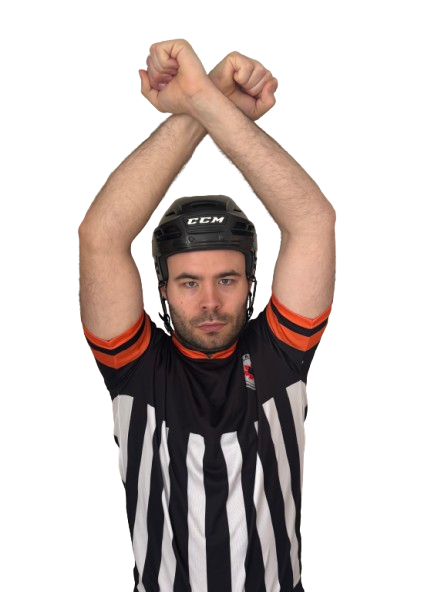
Rule 35. Penalty Shot
(a) Any infraction of the rules which calls for a Penalty Shot shall result in the following:
The Referee shall cause to be announced over the public address system the name of the player designated by their or selected by the team entitled to take the shot (as appropriate), and shall then place the ball on the centre face-off spot and the player taking the shot will, on instruction of the Referee, play the ball from there and shall attempt to score on the goaltender. The ball must be kept in motion towards the opponents’ goal line and once it is shot the play is to be considered complete. No goal can be scored on a rebound of any kind and any time the ball crosses the goal line, the shot shall be considered complete.
The “Spinerama” move is acceptable on a Penalty Shot as long as the ball is kept in continuous motion.
(b) The goaltender must remain in their goal crease until the designated player touches the ball at centre floor, and in the event of a violation of this rule, the player designated or selected to take the shot shall be entitled to take the shot over again. The goaltender may attempt to stop the shot in any manner except by throwing their stick or any other object, or deliberately dislodging the goal, in which case a Goal shall be awarded.
Note 1: No player other than the goaltender is permitted to tend goal during a Penalty Shot.
(c) In cases where a Penalty Shot has been awarded under Rule 24 (c) – Protective Equipment (deliberate removal of helmet or facial protector during a breakaway), Rule 55 (d) – for Delay of Game (Goaltender deliberately dislodging the goal during a breakaway), Rule 82 (a) – Throwing Stick (at ball or ball carrier), Rule 85 (d) – Tripping (fouling from behind), and Rule 70 (e) – Leaving the Players or Penalty Bench (ineligible player), the Referee shall designate the player who has been fouled as the player who shall take the Penalty Shot. If by reason of injury, the player designated by the Referee to take the Penalty Shot is unable to do so or again if the player fouled is not identifiable, the Penalty Shot shall then be taken by a player who was on the floor at the time of the infraction, and is selected by the Captain of the non-offending team and their selection reported to the Referee. In cases where a Penalty Shot has been awarded under Rule 55 (e) – Delay of Game, Rule 58 (c) – Falling on the Ball (in the goal crease) and Rule 61 (c) – Handling he Ball (in the goal crease), the Penalty Shot may be taken by a player selected by the Captain of the non-offending team and their selection reported to the Referee. This player must be on the floor at the time of the infraction.
(d) Should the player in respect to whom a Penalty Shot has been awarded, themselves commit a foul in connection with the same play or circumstances after the Penalty Shot has been awarded, they shall first be permitted to take the Shot before being sent to the penalty bench to serve the penalty, provided the penalty assessed was not a Game Ejection, Game Misconduct, Gross Misconduct or Match penalty. If at the time a Penalty Shot is awarded, the goaltender of the penalized team has been removed from the floor to substitute another player, the goaltender shall be allowed to return to the floor before the Penalty Shot is taken.
(e) While the Penalty Shot is being taken, players of both sides shall withdraw to the sides of the floor and beyond the centre red line.
(f) If, while the Penalty Shot is being taken, any player of the opposing team shall have by some action interfered with or distracted the player taking the Penalty Shot, and because of such action the shot should have failed, a second attempt shall be permitted and the Referee shall assess a Misconduct penalty to the player. If the interference is from a team official, a Game Misconduct penalty shall be assessed.
(g) If a goal is scored from the Penalty Shot, the ball shall be faced-off at centre face-off spot in the usual way. If the goal is not scored, the ball shall be faced-off at either end zone face-off spot in which the Penalty Shot was attempted.
(h) Should a goal be scored from a Penalty Shot, a further penalty to the offending player shall not be applied unless the offense for which the Penalty Shot was awarded was such as to incur a Major or Match penalty, in which case the penalty prescribed for the particular offense shall be assessed. If the offense for which the Penalty Shot was awarded was such as would normally incur a Minor penalty, then regardless of whether the Penalty Shot results in a goal or not, no further Minor penalty shall be served.
(i) A measurement of the stick of the player designated to take the Penalty Shot may be requested before the shot is taken, as if it were a normal play. Should the stick prove illegal, the offending team shall be denied the Penalty Shot and no further penalty shall be imposed. Should the measurement prove the stick to be legal, the Penalty Shot shall be taken in the normal manner and the penalty for an “unsustained request for a measurement” shall be assessed whether the Penalty Shot is successful or not.
(j) If the foul upon which the Penalty Shot is based occurs during actual playing time, the Penalty Shot shall be awarded and taken immediately in the usual manner notwithstanding any delay occasioned by a delayed whistle by the Referee to permit the play to be completed, which delay results in the expiry of the regular playing time in any period.The time required for the taking of a Penalty Shot shall not be included in the regular playing time or any overtime.
(k) In all instances where a penalty shot has been awarded it must be recorded on the gamesheet. The player’s number comitting the foul will be recorded under the penalty section of the offending team. Penalty shot fouls will count towards the 3 penalty game ejection rule.
(l) Note: Also refer to:
Rule 24 (c) Rule 58 (c) Rule 82 (a)
Rule 55 (d) Rule 61 (c) Rule 85 (d)
Rule 55 (e) Rule 70 (e)
SITUATION 1
A Penalty Shot may be awarded due to the following illegal acts:
1. Rule 19 (f) – Change of Players
When, in the last two minutes of regular playing time, a team is penalized for DELIBERATE illegal substitution (deliberately having too many players on the floor). Also refer to Rule 55 (e).
2. Rule 24 (c) – Protective Equipment
a. When a goaltender or any other defending player deliberately removes their helmet or facial protector during the course of a break away in the neutral or attacking zone. Rule 24, Situation 6.
b. When a defending player deliberately participates in the play without a helmet or facial protector during the course of a breakaway in the neutral or attacking zone. Rule 24, Situation 5.
c. When a goaltender in their defending zone, deliberately removes their helmet or facial protector during the last two minutes of regular playing time, or any time in overtime. Rule 24, Situation 4. Also refer to Rule 55 (e).
3. Rule 55 (c) – Delay of Game
When a goaltender or any other defending player, in their defending zone, deliberately dislodges the goal from its position during the last two minutes of regular playing time, or any time in overtime. Also refer to Rule 55 (e).
4. Rule 55 (d) – Delay of Game
When a goaltender deliberately dislodges the goal from its position during the course of a breakaway in the neutral or attacking zone.
5. Rule 55 (e) – Delay of Game
When, in the last two minutes of regular playing time, or any time in overtime, a team is penalized for:
a. Deliberate illegal substitution Rule 19 (f), or
b. Deliberately removing a helmet or facial protector Rule 24 (c), or
c. Deliberately knocks the goal from its position Rule 55 (c), or
d. Refusing to start play Rule 78 (a).
6. Rule 58 (c) – Falling on the Ball
When a defending player (except the goaltender) deliberately falls on the ball, holds or gathers the ball into their body in any manner or picks up the ball with their hand, while the ball is within their goal crease. Rule 58, Situation 1 7. Rule 61 (c) – Handling the Ball
When a defending player (except the goaltender) picks up the ball from the floor with their hand while the ball is in their team’s goal crease.
8. Rule 70 (e) – Leaving the Player’s Bench or Penalty Bench
When a player on a breakaway in the neutral or attacking zone is interfered with by a player of the opposing team who shall have illegally entered the game or by a player or team official on the players’ or penalty bench. Rule 70, Situations 1, 2, and 3
9. Rule 78 (a) – Refusing to Start Play
When, in the last two minutes of regular playing time, or any time in overtime, the Coach is assessed a Major penalty plus a Game Misconduct for refusing to start
play, a Penalty Shot shall also be awarded against that team. Also refer to Rule 55 (e).
10. Rule 82 (a) – Throwing Stick
When any player of the defending team, including the goaltender, deliberately throws their stick or any part thereof, or any other object at the ball or ball carrier in the defending zone.
11. Rule 85 (d) – Tripping
When a player in control of the ball on a breakaway in the neutral or attacking zone is tripped or otherwise fouled from behind and thus prevented from having a
clear shot on goal, having no opponent to pass other than the goaltender.
SITUATION 2
Where a Penalty Shot has been awarded during a game, this shall be recorded on the Official Game Report, along with the time it was awarded, the player designated to take the shot and whether or not the goal was scored on the play. In order to assess a Penalty Shot as a result of a foul against the ball carrier, the following conditions must be met:
1. The attacking player must have control of the ball.
2. The determining factor is the position of the ball when the infraction is committed. The ball must be in the neutral or attacking zone when the infraction is committed.
3. The attacking player must have no defending player to pass other than the goaltender.
4. The attacking player must be fouled from behind.
5. The attacking player must have been denied a reasonable scoring opportunity.
Note: In point No. 5 of this situation, where reference is made to the “attacking player”, it means the player in possession and control of the ball.
EXAMPLE: If two players are on a breakaway in the neutral or attacking zone and the player in control of the ball is fouled from behind, causing them to lose control of the ball and the other attacking player picks up the ball and gets a clear shot on goal and does not score, a Penalty Shot must still be awarded to the player originally fouled.
SITUATION 3
General Notes on Penalty Shots:
1. A goaltender is the only player allowed to defend the goal during a Penalty Shot (except as explained in Rule 20, Situation 3 and in Rule 35, Situation 4).
2. A substitute goaltender is not allowed a warm-up prior to a Penalty Shot – Rule 16 (f).
3. A player to whom a Penalty Shot has been awarded who themselves commits a foul in connection with the same play or circumstances after the Penalty Shot has been awarded, will be allowed to take the Penalty Shot, provided the penalty they are to be assessed is not a Game Ejection, Game Misconduct, Gross Misconduct or Match penalty – Rule 35 (d).
4. A player of the opposing team who distracts a player taking a Penalty Shot is to be assessed a Misconduct (whether a goal is scored or not) and if the Penalty Shot fails, another attempt is awarded – Rule 35 (f). If it were a team official involved, the penalty assessed would be a Game Misconduct rather than the Misconduct.
5. If the foul on which the Penalty Shot is based occurs during the actual playing time, the Shot will be awarded in all cases, even though regular playing time in any period may have expired – Rule 35 (j).
SITUATION 4
QUESTION: A team is playing with 6 players and does not have a goaltender dressed in goaltender’s equipment. A Penalty Shot is awarded against that team. Who defends the goal against the Penalty Shot?
ANSWER: Since the team has no goaltender, they must designate a player. This player shall be entitled to the privileges of a goaltender and must follow the same rules and procedures as a regular goaltender during the Penalty Shot. They are not required to wear the entire goaltender’s equipment but must wear the mandatory equipment as covered by the rules; helmet, facial protection and goaltenders stick. After the Penalty Shot has been taken, the player may be classified again as a regular player. This only applies when a team has no goaltender and only in the case of a Penalty Shot.
SITUATION 5 Rule 35 (d)
A player who has been awarded a Penalty Shot, is assessed a Match penalty for a foul in connection with the same play or circumstances after the Penalty Shot has been awarded. How do you handle this situation?
ANSWER: The player shall NOT be permitted to take the Penalty Shot and the Captain shall designate another player (on the floor at the time of the infraction) to take the Penalty Shot.
SITUATION 6 Rule 35 (a) states
“…The ball must be kept in motion towards the goal line…”
QUESTION: On a Penalty Shot, while going in on the goal, the player loses control of the ball or over runs it, forcing them to go back and retrieve it and then make their play on the goal. Is this legal?
ANSWER: As long as the ball continues in motion towards the opponent’s goal line, the player may go back and pick up the ball.
QUESTION: On a Penalty Shot, the player advances to the ball and inadvertently misses the ball. The ball has not been put into motion. Can the player circle back and start again?
ANSWER: Yes, but once the ball is put into motion, it must be kept in motion towards the goal.
SITUATION 7 Rule 35 (a)
On a Penalty Shot, as the player approaches the goal, the goaltender poke checks the ball. The ball bounces past the goaltender toward the net. The player regains the ball and directs it into the goal. Is the goal allowed?
RULING: No goal. Once the goaltender has made contact with the ball causing the player to lose control, the player can no longer touch the ball. However, if the ball continues on with its own momentum into the goal, the goal shall be allowed.
SITUATION 8 Rule 35 (a) states
“…No goal can be scored on a rebound of any kind and any time the ball crosses the goal line, the shot shall be considered complete”. The word “rebound” seems to cause considerable confusion with respect to a goal being scored on a Penalty Shot. The following is a brief summary and intent of the words “No goal can be scored on a rebound of any kind”. The player taking the Penalty Shot shoots the ball and:
1. The ball hits the goal post then goes into the goal – Goal is allowed.
2. The ball hits the goaltender then goes into the goal – Goal is allowed.
3. The ball hits the goal post, then hits the goaltender and goes into the goal – Goal is allowed.
4. The ball hits the goaltender, then hits the goal post and goes into the goal – Goal is allowed.
5. The ball, after being shot, contacts the boards or attacking player, and then goes into the goal. No goal.
SITUATION 9 Rule 35 (a)
QUESTION: On a Penalty Shot, the ball hits the glass behind the goaltender, bounces back, hits the goaltender on the back and goes into the goal. Is the goal allowed?
ANSWER: No. As soon as the ball crosses the goal line the Penalty Shot shall be considered complete.
SITUATION 10 Rule 35 (i)
A player has been awarded a Penalty Shot. The opposing team requests a measurement of that player’s stick prior to the Penalty Shot being conducted. QUESTION: What happens if the player refuses to surrender their stick or intentionally breaks the stick, when asked to surrender it for measurement?
ANSWER: The player’s team shall be denied the Penalty Shot, and the player guilty of this gesture shall be assessed a Misconduct. Please note that the Minor penalty for an illegal stick would not be assessed, as that penalty is offset by the cancellation of the Penalty Shot.
SITUATION 11 Rule 35 (i)
After a Penalty Shot has been executed, and regardless of whether a goal is scored, either team may request a stick measurement of any player on the floor prior to the resumption of play. The one measurement per stoppage of play would apply. However, the results of the stick measurement will in no way affect anything that has occurred prior to the measurement.
SITUATION 12 Rule 35 (b)
If a goaltender leaves their goal crease too soon on a Penalty Shot, the Referee shall allow the play to be completed and if a goal is not scored, the player shall be allowed to repeat the Penalty Shot. If it is apparent that the goaltender is trying to delay the game, warn them that a second violation will result in a Misconduct. Any subsequent delay would entail a Game Misconduct.
SITUATION 13
Team “A” No. 10 is serving a Minor penalty. Another player of Team “A”, No. 8, is to be assessed a delayed penalty for slashing. Before play is stopped, Team “B” is awarded a Penalty Shot, due to an additional foul by Team “A”. Team “B” scores on the Penalty Shot.
RULING: The penalty to Team “A” No. 10 remains in effect, and Team “A” No. 8 must serve the time penalty for slashing.
Note: Goals scored on a Penalty Shot do not affect penalties being served or on delay. See Rule 28 (b).
SITUATION 14 Rule 35 (h)
A player on a breakaway in the neutral or attacking zone is fouled in such a way that the infraction would incur a Major penalty plus an automatic Game Misconduct, (i.e. slashing resulting in an injury) as well as a Penalty Shot, if a goal is not scored before the stoppage of play. However, the player scored on the Penalty Shot. RULING: The Major penalty plus an automatic Game Misconduct is assessed, regardless of the fact that a Penalty Shot is awarded on the play and regardless of
the fact that a goal may be scored on the play or on the Penalty Shot.
SITUATION 15
QUESTION: A player on a breakaway in the neutral or attacking zone is fouled from behind and the Referee signals a Penalty Shot. Before the play is completed a second infraction is signaled against the same team, whether it be to the same player or a different player. The Penalty Shot washes out the first infraction. Is
the penalty for the second infraction still assessed?
ANSWER: Yes
SITUATION 16
A player on a breakaway in the neutral or attacking zone is tripped or fouled from behind by an opponent, such that a Penalty Shot would be awarded. Before play is stopped, a player or the goaltender of the offending team throws a stick or any other object at the ball in the defending zone.
RULING: Award two Penalty Shots. If a goal is scored on the first Shot, cancel the second Shot. However, the appropriate penalty, as prescribed by the rules, shall be assessed for the second infraction (i.e., hooking, slashing, etc.).
Note: A maximum of 2 Penalty Shots may be awarded to either one or two players (depending on the situation) during the same play sequence. If any further infraction warranting the awarding of third Penalty Shot was committed by the same team during the same play sequence, that Penalty Shot would be replaced by the appropriate penalty, as prescribed by the rules.




FOLLOW US!
LINKS
Events
Officials
News
CONTACT US
Send an Email
(647) 781-1818
Ontario Ball Hockey Federation © 2021